Strategic Fastener Sourcing for Industrial Success: Quality, Compliance, and Global Supply

Annie Z
AuthorWith over 25 years of experience in fastener production and export sales, we operate our own manufacturing plant and our products are exported to over 50 countries. We are professional experts in bolts, nuts, washers, anchor bolts, and customized fasteners.
Introduction: The Critical Role of Industrial Fasteners in Manufacturing and Construction
Bolts, screws, nuts, and custom fastening components are the unsung heroes holding together modern infrastructure, machinery, and transportation systems. From high-rise steel frameworks to precision automotive assembly lines, threaded fasteners and engineering fasteners bear loads that design engineers count on every day. Yet behind every reliable joint lies a procurement challenge that few outsiders appreciate.
Procurement teams face mounting pressure: balancing cost against lead time, verifying quality certifications across international supply chains, and managing global logistics — all while avoiding production delays that cascade into six-figure losses. When a single batch of substandard industrial bolts can halt an entire manufacturing line, sourcing decisions become strategic, not transactional. This article examines how partnering with a technically competent fastener supplier transforms industrial procurement from a recurring headache into a measurable competitive advantage.
Understanding Customer Challenges in Fastener Procurement
Across industries, fastener manufacturer relationships fracture under the weight of inconsistent quality, unpredictable lead times, and absent technical support. Procurement directors regularly report shipments arriving without Material Test Certificate documentation — a paperwork gap that triggers quarantine delays and supplier audits. Equally damaging are non-conforming surface finishing results: zinc flaking, uneven coating thickness, or inadequate adhesion that reveals itself only after installation.
The consequences compound quickly. Fasteners specified for marine or chemical environments demand rigorous corrosion resistance, yet insufficient salt spray testing verification lets underperforming products reach the job site. Without proper tensile testing and mechanical validation, fastener failures become liability events — warranty claims, structural rework, and in the worst cases, safety incidents that damage reputations beyond repair.
These gaps aren't inevitable. They're addressable through custom technical drawings, upfront material specification, and ODM fasteners engineered to exact application requirements. The difference lies in whether your supplier treats quality assurance as overhead or as infrastructure.
Industry Trends Driving the Fastener Market
The global industrial fasteners market continues its upward trajectory, with projections placing market value between $103.9 and $124.2 billion by the 2032–2034 horizon. Infrastructure renewal programs, renewable energy installations, and manufacturing automation each contribute to sustained demand for manufacturing fasteners across every economic region. Construction activity in Asia-Pacific and the Middle East, combined with automotive electrification in Europe and North America, keeps production capacity tight. We're tracking these shifts closely — our latest industry outlook on Class 12.9 demand details how high-strength specifications are reshaping procurement priorities.
Corrosion-resistant and high-strength fastener categories are claiming disproportionate share of this growth. Hot-dip galvanized and zinc-nickel coating specifications now dominate RFQs in construction, heavy machinery, and energy sectors where service life expectations stretch to decades. Simultaneously, technical sourcing services are evolving from nice-to-have to essential — engineering teams expect suppliers to contribute material selection guidance, custom fasteners development, and documented compliance with DIN, ISO, and EN standards as baseline capabilities, not premium add-ons.
Key Product Categories for Industrial Applications
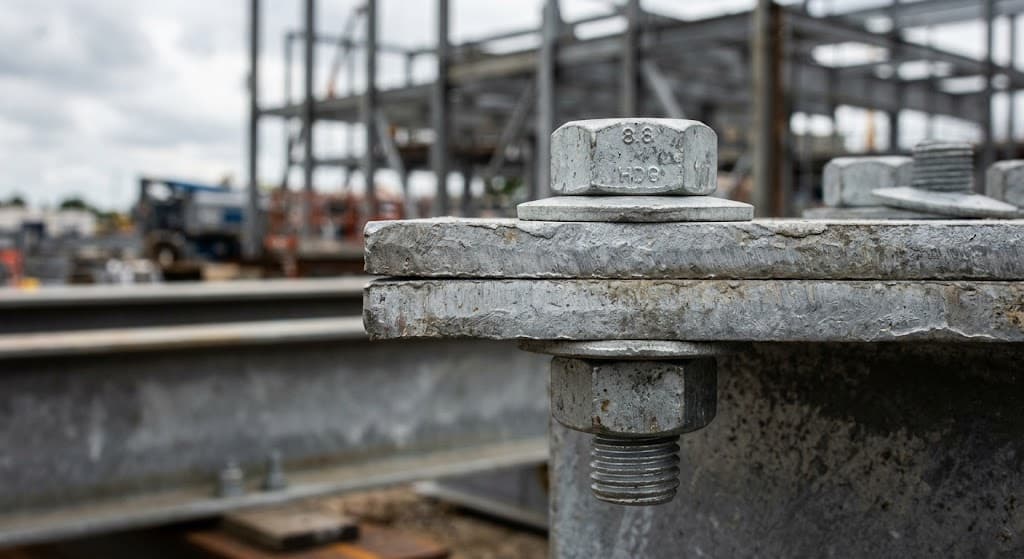
Heavy-duty hexagonal bolts manufactured to DIN933 and DIN931 standards remain the workhorse of machinery fasteners procurement. Specified in grade 8.8 carbon steel fasteners with black oxide or hot-dip galvanized finish, these hex bolts anchor everything from conveyor systems to bridge gusset plates. The difference between a commodity hex bolt and an application-engineered one surfaces only under load — and by then, it's too late to renegotiate.
Expansion anchor bolts represent another category where specification precision matters. Available in both hot-dip galvanized and wedge-type configurations, these standard fasteners deliver secure anchoring into concrete, brick, and stone substrates for infrastructure anchoring, medical equipment installation, and structural steel connections. The load path from anchor to substrate leaves zero margin for metallurgical compromise.
For underground construction, specialized tunnel segment bolts with dual hot-dip galvanized and Dacromet coatings ensure reliable segment splicing in subway, water diversion, and mining projects where groundwater exposure is continuous. Similarly, guardrail splicing bolts with burr-free round heads and certified rust-resistant finishes meet the visibility and durability requirements of municipal and traffic safety specifications.
Across all these categories, customization is standard practice — not an exception. OEM fasteners and custom fasteners with modified lengths, specialized thread forms, custom packaging configurations, and private-label marking (with negotiable minimum order quantities) support branded product lines and proprietary assembly processes without forcing procurement into off-the-shelf compromises.
Quality Assurance and Certification: Non-Negotiable for Global Supply
For critical applications, traceable quality documentation separates suppliers who understand liability from those who only understand price. ISO 9001-certified manufacturing facilities — like those we operate and audit — provide the process discipline that makes product consistency repeatable rather than coincidental. We've invested in the infrastructure to prove it; read about how our ISO 9001 certification advantage translates into procurement confidence. EN 10204 3.1 inspection certificates accompany shipments destined for pressure vessel, lifting equipment, and structural steel applications where material provenance carries legal weight.
Material Test Certificates (MTCs) confirm chemical composition and mechanical properties — tensile strength, yield point, elongation, and hardness — for each production batch. These aren't administrative formalities. They're the documentary chain that links a finished bolt to its heat number, its raw material pedigree, and its performance under calibrated testing conditions. When an auditor asks for traceability, MTCs are the answer.
Surface finishing processes undergo equally rigorous verification. Hot-dip galvanizing, zinc-nickel coating, nickel plating, and PTFE coating each serve distinct corrosion protection and friction-control functions — and each requires salt spray testing to validate performance claims. The growing adoption of zinc-nickel in automotive and industrial applications is something we've covered in depth; our analysis of the zinc-nickel coating trend explains why this technology is displacing traditional zinc in demanding environments.
Behind every certified fastener sits a manufacturing sequence — cold forged fasteners formed under immense pressure, threads rolled rather than cut for superior fatigue resistance, and CNC machined components where geometry tolerances demand chip-making precision. Our advanced metrology lab validates dimensional accuracy at every stage, catching deviations before they become your production problem.
Global Logistics and Technical Sourcing Support
FastenersB2B delivers end-to-end sourcing that bridges the gap between engineering intent and on-site inventory: custom technical drawings developed in collaboration with your design team, material grade selection informed by application loads and environmental conditions, production monitoring with in-process inspection, and global logistics coordination spanning factory floor to your receiving dock — including customs clearance documentation that prevents border delays.
Lead times respond to planning, not hope. Strategic inventory positioning and production scheduling optimized across our factory network mean bulk industrial procurement orders ship on predictable timelines, even when specifications demand non-standard dimensions or specialized coatings. For real-time supply chain intelligence, our lead time watch on the fastener supply chain provides quarterly visibility into capacity trends and potential bottlenecks.
Direct factory partnerships eliminate intermediary markups while preserving — and often improving — quality oversight. One construction firm documented a 40% reduction in fastener-related failure incidents after transitioning from a multi-tier distribution model to a single global fastener supplier relationship with full MTC transparency and validated coating performance. The savings extended beyond material cost into reduced rework hours, fewer inspection stoppages, and accelerated project closeout.
Conclusion: Partner with FastenersB2B for Reliable Fastening Solutions
Whether your project demands standard hex bolts in bulk quantities, heavy-duty expansion anchors for critical anchoring, or fully customized threaded fasteners engineered to proprietary specifications, Fasteners B2B brings together certified manufacturing, documented quality assurance, and global fulfillment capability under a single supplier relationship. The fasteners in your assembly might be small — but the consequences of sourcing them poorly never are.
Let us help you secure your supply chain — one certified, documented, on-time shipment at a time. Contact our technical sourcing team to discuss your requirements, request material samples, or obtain a project-specific quotation.
Related News
Other news you might be interested in
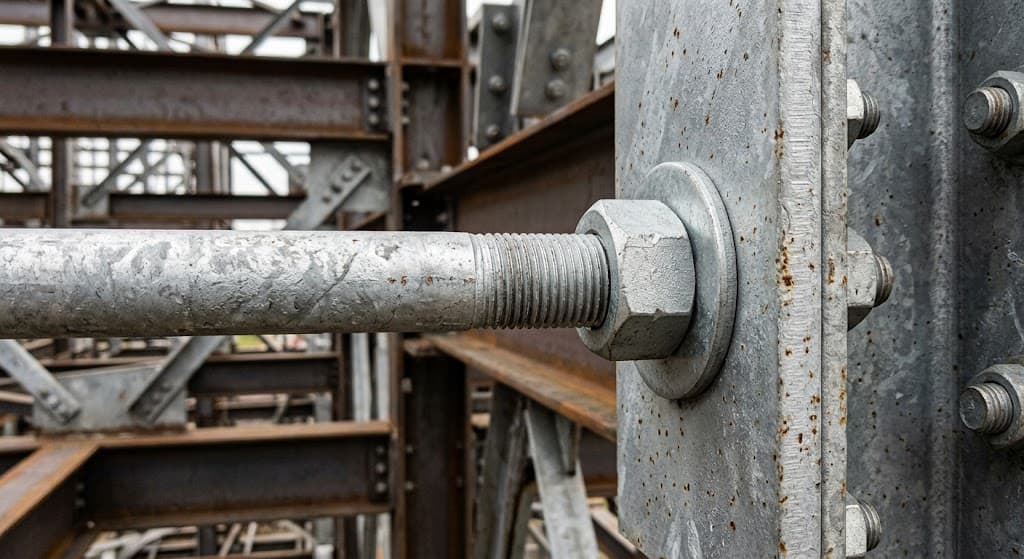
How to Specify Hot Dip Galvanized Tie Rods for Steel Bracing: Diameter, Thread Length and RFQ Checklist
Learn how to specify hot dip galvanized tie rods for steel bracing and tension applications. Check diameter, thread length, coating, matching components and RFQ requirements.
How to Select Hot Dip Galvanized Washers for Steel Structures
Learn how to select hot dip galvanized flat, square and beveled washers for steel structures. Compare washer functions, bolt compatibility, corrosion protection and RFQ requirements.
Want to know more?
Get in touch with us for more information about our services and products.