
The Ultimate Engineering & Sourcing Guide: HDG U-Bolts vs. V-Bolts

Annie Z
AuthorWith over 25 years of experience in fastener production and export sales, we operate our own manufacturing plant and our products are exported to over 50 countries. We are professional experts in bolts, nuts, washers, anchor bolts, and customized fasteners.
If you are designing heavy piping systems, securing telecommunication masts, or building marine infrastructure in C3 to C5 corrosive environments, fastening a cylindrical object to a flat structural plane is a daily engineering challenge.
The two undisputed kings of this application are U-Bolts and V-Bolts. While they are both manufactured by bending threaded steel rods, their structural mechanics, load distribution, and manufacturing tolerances are completely different. Sourcing these components incorrectly can lead to crushed pipes, spinning antennas, or catastrophic zinc-cracking under heavy wind loads.
As a premier direct fastener manufacturer operating out of Handan, China, the Hotop Fasteners engineering team bends, threads, and hot-dip galvanizes thousands of tons of these components annually. In this comprehensive guide, we strip away the marketing fluff. We will explain the mechanical physics of U-Bolts vs. V-Bolts, how to choose the right steel grade, and the hidden dangers of hot-dip galvanizing bent fasteners.
Part 1: The U-Bolt (Universal Load Distribution)
The Mechanics of a U-Bolt
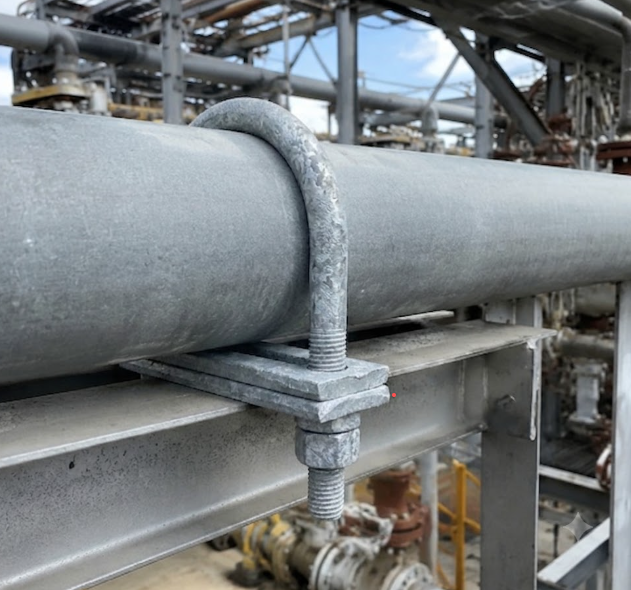
A U-Bolt features a smooth, continuous semi-circular inner profile. It is mathematically engineered to perfectly hug the Outer Diameter (OD) of a round pipe. When the nuts are tightened, the U-bolt acts like a saddle, distributing the immense clamping force evenly across the lower 180 degrees of the pipe's surface.
Primary Applications:
- Heavy Fluid Pipelines: Suspending water mains, gas lines, or petrochemical pipes from Unistrut channels. The even load distribution prevents the thin walls of the pipe from denting or crushing under high torque.
- Automotive Leaf Springs: Securing truck and heavy trailer axles, where a wide, even clamping force is required to handle massive vertical shock loads.
- Marine Pilings: Securing round wooden posts to flat steel docks in saltwater environments.
The "Nominal Size" Sourcing Trap:
The most common mistake overseas buyers make is ordering U-bolts based on "Nominal Pipe Size" (NPS) rather than exact dimensions. A standard 2" pipe does not have a 2-inch outer diameter; its actual OD is 2.375" (60.3mm). If your factory bends a U-bolt to exactly 2 inches, it will not fit over the pipe.
Expert Tip: Always provide your Chinese supplier with the exact Center-to-Center (C-to-C) width, the Inner Width, and the Inner Length to avoid expensive site failures.
Part 2: The V-Bolt (The Anti-Torsion Grip)
The Mechanics of a V-Bolt
A V-Bolt replaces the smooth bottom curve with a sharp, V-shaped vertex (typically a 90-degree bend). This fundamentally changes the physics of the joint. When a V-bolt clamps down on a round pipe, it creates a powerful "wedge effect." Instead of hugging the surface, the V-shape forces the pipe into a strict, aggressive 4-point contact grip against the mounting bracket.
Primary Applications:
- Telecommunications & 5G Antennas: This is the absolute #1 use case for V-Bolts. When high winds hit a telecom mast or a parabolic dish, it generates massive rotational force (torsion). A smooth U-bolt acts like a hinge, allowing the mast to spin. A V-bolt bites into the mast, completely locking it and preventing any twisting.
- Signage and Traffic Infrastructure: Securing heavy highway signs to round posts where wind uplift and rotation are constant threats.
- Square/Diamond Tubing: V-bolts are excellent for clamping square tubing oriented in a diamond position, where a round U-bolt would simply crush the sharp corners.
Part 3: Material Selection (Q235 vs. High Tensile Steel)
When sending drawings to a Chinese factory, selecting the right steel grade is critical to balancing cost and performance.
1.Q235 (Mild Carbon Steel)
Equivalent to ASTM A36 or S235, this is the most common material for standard pipe clamps. It is highly ductile, making it very easy for the factory to bend without creating internal stress fractures. If you are suspending standard indoor/outdoor plumbing or electrical conduit, Q235 is perfectly adequate and highly cost-effective.
2.35# or Q345 (Medium Carbon / High-Strength Steel)
Equivalent to ASTM A572 or Class 8.8. If you are securing a heavy telecom tower mast or an automotive axle, Q235 will stretch and yield under the tension. You must upgrade to high-strength steel. However, bending high-strength steel requires heavier hydraulic machinery and extreme care to avoid snapping the rod during the cold-forming process.
Part 4: The Manufacturing Nightmare – Bending + Hot Dip Galvanizing
Because U-Bolts and V-Bolts are primarily used in exposed outdoor environments (C3 to C5 corrosivity categories), they must be Hot Dip Galvanized (HDG) per ISO 10684 or ASTM A153. But combining a bent metal shape with 450°C (842°F) molten zinc creates extreme manufacturing challenges that separate real factories from cheap trading companies.
The Zinc Cracking Phenomenon
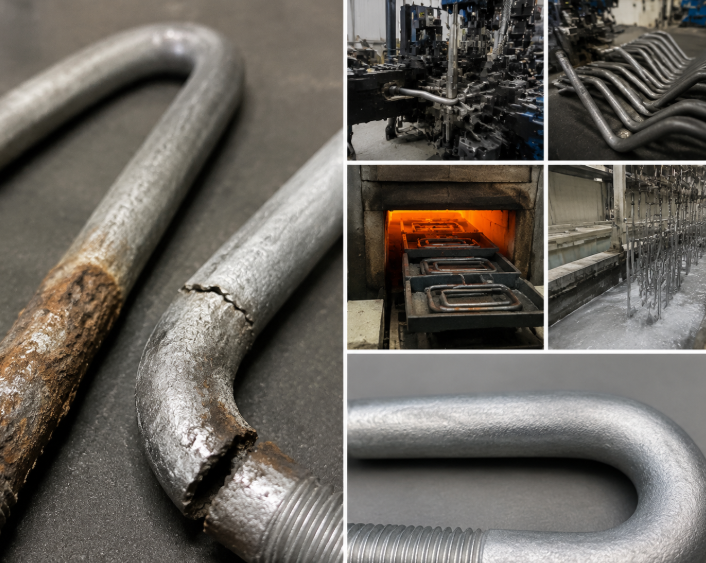
When a steel rod is bent into a tight "U" or a sharp "V", extreme mechanical stress builds up at the vertex of the bend (the outer edge stretches, the inner edge compresses). If a low-end factory throws this highly stressed, cheaply bent steel directly into a 450°C zinc bath, the sudden thermal shock causes the steel to flex. Micro-cracks form at the bend. The zinc coating then fractures, exposing the bare steel underneath. Within six months, the bolt will rust heavily and snap exactly at the bottom of the bend.
The Hotop Fasteners Solution:
- Controlled Bend Radii: We utilize precision CNC bending machines. For V-bolts, we ensure the inner radius is mathematically calculated to relieve stress rather than amplify it.
- Stress Relief: For high-strength V-bolts, we implement stress-relieving protocols before galvanizing.
- Thick, Uniform Coating: We rigorously control the acid pickling time (to prevent hydrogen embrittlement) and the zinc immersion time, guaranteeing a thick (>50μm), crack-free zinc-iron alloy coating at the most critical stress points.
Part 5: The Golden Rules of HDG Assembly (Threads & Washers)
A perfectly bent and galvanized bolt is useless if you cannot assemble it on the job site.
1.The Overtapping Protocol (6AZ Tolerance)
Hot dip galvanizing adds up to 85μm of zinc to the threaded legs of the U/V-bolt. If your supplier sends you standard-tapped hex nuts, your ironworkers will not be able to thread them past the first pitch. At Hotop Fasteners, we strictly supply matching heavy hex nuts that have been CNC overtapped (+0.4mm to +0.8mm) after the galvanizing process, ensuring a smooth, free-spinning fit.
2.The Importance of Plate Washers
When securing a U-Bolt or V-Bolt to a slotted Unistrut channel, standard round flat washers are dangerous. Under high torque, a round washer will buckle and pull right through the slotted hole. You must use heavy-duty HDG Square Plate Washers (e.g., DIN 436). Their wide, straight edges bridge the channel slots perfectly, preventing the U-bolt legs from bending inward when tightened.
Part 6: Heavy Cargo Export Logistics
U-Bolts are awkward, bulky, and heavy. Poor packaging leads to damaged threads and moisture intrusion during a 30-day ocean voyage.
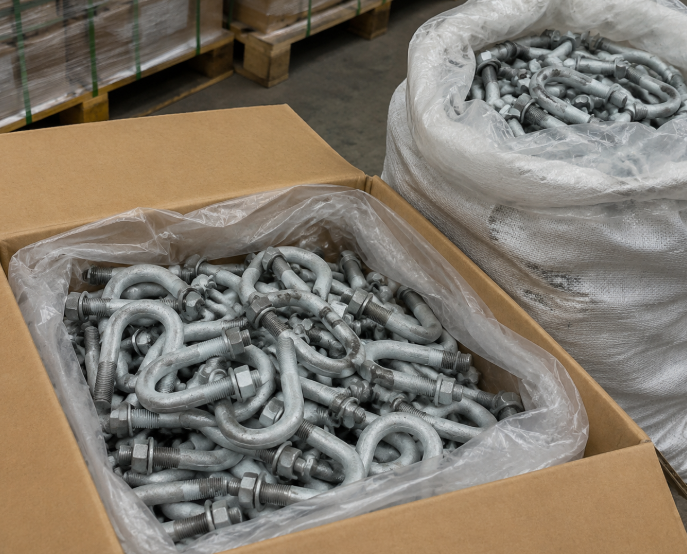
As a veteran exporter, we pack our HDG U-Bolts and V-Bolts in heavy-duty, double-corrugated export cartons (or heavy woven gunny bags for massive diameters). Critically, every package is lined with a thick PE plastic moisture barrier to completely block "container rain" and ocean salinity. These packages are densely stacked on fumigation-free plywood pallets and bound with high-tension PET strapping, optimizing your 20GP container payload and ensuring your hardware arrives rust-free and ready to install.
---
Don't let a middleman guess your bending tolerances, thread clearances, or zinc thickness requirements.
If you are building critical telecommunications infrastructure, solar racking, or heavy piping systems, deal directly with the engineering source.
Related News
Other news you might be interested in
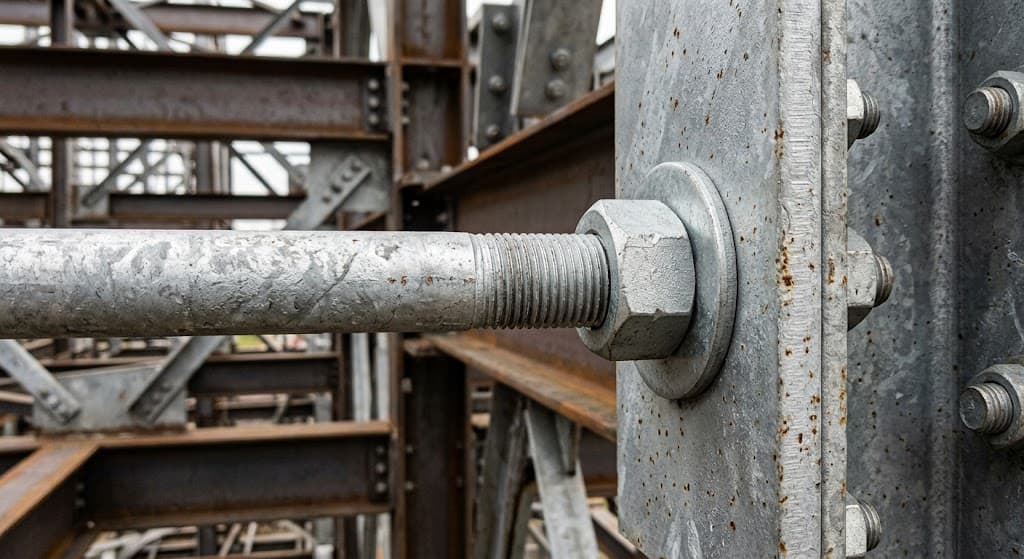
How to Specify Hot Dip Galvanized Tie Rods for Steel Bracing: Diameter, Thread Length and RFQ Checklist
Learn how to specify hot dip galvanized tie rods for steel bracing and tension applications. Check diameter, thread length, coating, matching components and RFQ requirements.
How to Select Hot Dip Galvanized Washers for Steel Structures
Learn how to select hot dip galvanized flat, square and beveled washers for steel structures. Compare washer functions, bolt compatibility, corrosion protection and RFQ requirements.
Want to know more?
Get in touch with us for more information about our services and products.