Industrial Fastener Sourcing: A Strategic Guide for B2B Procurement

Annie Z
AuthorWith over 25 years of experience in fastener production and export sales, we operate our own manufacturing plant and our products are exported to over 50 countries. We are professional experts in bolts, nuts, washers, anchor bolts, and customized fasteners.
The Critical Role of Quality in Industrial Fastener Procurement
In industrial procurement, the true cost of a fastener is measured long after the invoice clears. A failed joint—whether from wobbling under vibration, leakage at a pressure boundary, or compromised load transmission—can shut down an assembly line, delay a construction milestone, or void a warranty on heavy equipment. B2B buyers who treat threaded fasteners as a commodity invite exactly these risks into their supply chain. Every specification decision carries downstream consequences for safety, uptime, and project economics.
The market is responding to this reality. The automotive fastener segment alone is expanding at a 5.30% annual rate, driven by electrification, lightweighting, and increasingly demanding performance envelopes. That growth pulls engineering fasteners and machinery fasteners into tighter tolerance regimes across every sector that depends on them. It also means more suppliers are entering the space—and not all of them have the technical depth or quality infrastructure to back up their catalog claims.
This is where specification discipline separates strategic buyers from reactive ones. Standards like DIN933, EN 10204 3.1, and ISO 9001 are not paperwork formalities. They are the contractual backbone of a reliable fastener supply chain. A fastener manufacturer that maintains ISO 9001 certification and supplies EN 10204 3.1 documentation gives you auditable traceability from raw material to final product. Without that documentation, you are essentially buying on faith—and faith does not hold up under torque load or environmental exposure.
Surface Finishing: Endurance Beyond Corrosion Resistance
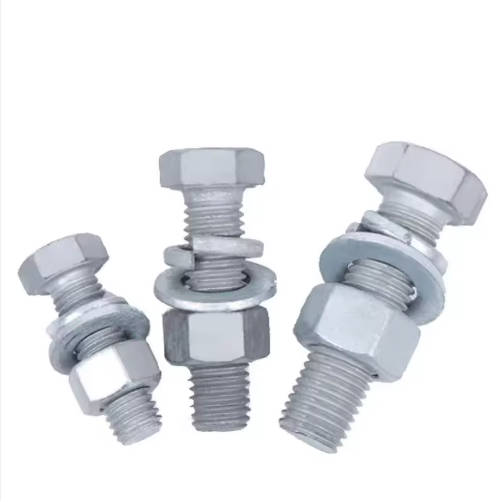
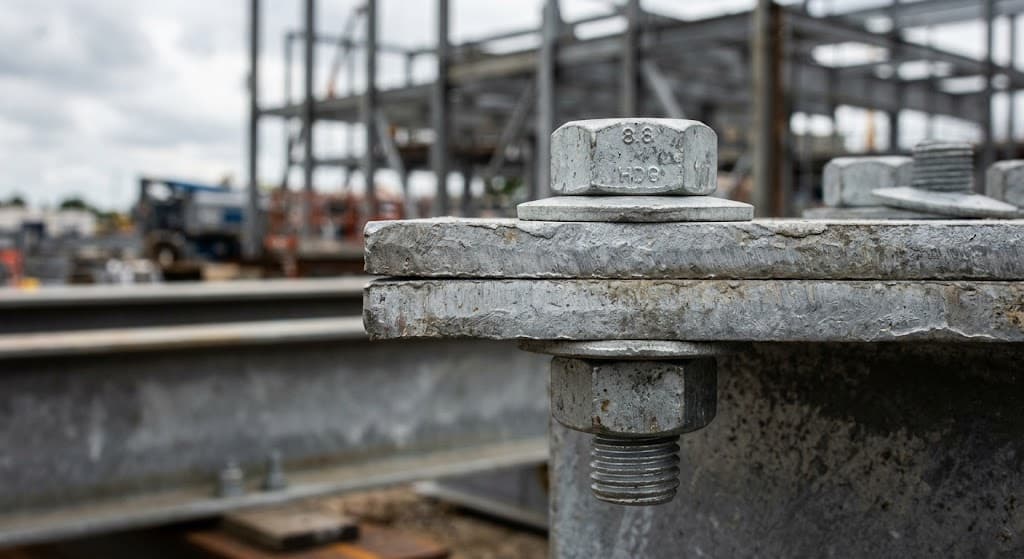
Surface finishing is where too many procurement teams under-specify, and where the difference between a five-year and a twenty-five-year service life is decided. Hot-dip galvanized fasteners remain the workhorse for outdoor infrastructure—construction anchors, bridge hardware, guardrail systems—because the zinc layer provides both barrier and sacrificial protection. But the choice of finish should be driven by the specific failure mode you are designing against, not by what happens to be in stock.
Validation is non-negotiable here. Reputable fastener suppliers validate their finishes through salt spray testing to quantify corrosion resistance under accelerated conditions, and tensile testing to confirm that the finishing process did not introduce hydrogen embrittlement or degrade mechanical properties. These test reports should be part of your Material Test Certificate (MTC) documentation—not a separate line item you have to chase down after delivery.
For demanding environments, the conversation has moved beyond basic zinc. Zinc-nickel coating has emerged as a preferred option for automotive and industrial applications where higher corrosion thresholds and consistent torque-tension behavior are required. Similarly, nickel plating offers excellent wear resistance and electrical conductivity, while PTFE coating delivers low-friction performance for assemblies that require precise clamp load control. Chrome plating remains the choice where hardness and aesthetic longevity matter. For machinery and automotive components that need a controlled black appearance without adding dimensional bulk, black oxide delivers oxidation resistance and precision—though it requires supplementary oil or wax for meaningful corrosion protection in humid environments.
Featured Products Engineered for Heavy-Duty Applications
General-purpose catalogs rarely solve application-specific problems. Here are four industrial bolts and fastener sets engineered for the kind of heavy-duty work that punishes generic hardware.
Our HDG round head guardrail splicing bolts are purpose-built for fence systems, steel structure splicing, and municipal traffic infrastructure. The heads are produced burr-free, which matters when you are installing hundreds of units and cannot afford a single snag or seating irregularity. Tensile strength is stable across production lots, and the hot-dip galvanized finish stands up to years of roadside exposure.
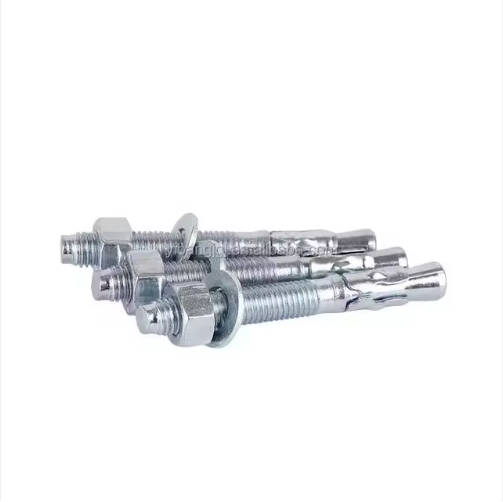
For anchoring into concrete and masonry, our hot-dip galvanized expansion anchor bolts are manufactured to GB/T standards and provide slip-proof fixing under sustained load. These are proven in industrial construction environments as well as medical equipment installation, where floor anchoring integrity is a life-safety issue, not an aesthetic one.
The DIN933 hex bolt and nut set in hot-dip galvanized finish is the standard-bearer for global supply chain compatibility. Hex bolts of this class are available in customizable lengths from 20mm to 65mm and threads from M6 to M18. Standardization matters because your maintenance teams, your contractors, and your field engineers all need interchangeable components that do not require special tooling or proprietary knowledge to service.
For high-load assemblies, our Grade 8 high-strength hex bolt sets with hot-dip galvanization deliver anti-loosening performance across M8 to M20 diameters. These are the carbon steel fasteners that carry the heaviest responsibility in machinery, construction, and automotive applications—and they are produced on automated production lines that maintain consistent heat treatment and thread geometry batch after batch.
Custom Fasteners and the Power of ODM Manufacturing
Standard fastener catalogs cover perhaps 70% of industrial applications. The remaining 30%—the assemblies where off-the-shelf dimensions do not fit, where material requirements exceed commercial grades, or where integration constraints demand unique geometry—require custom fasteners engineered from custom technical drawings. This is where ODM manufacturing separates a true manufacturing partner from a reseller with a catalog.
Cold forged fasteners begin with your drawings and are produced through a combination of cold forging for raw geometry, CNC machined components for precision features, and thread rolling for fatigue-resistant thread profiles. The result is a fastener that matches your tolerance requirements and mechanical property specifications exactly—not approximately. For buyers managing Class 12.9 high-strength requirements or other specialized grades, this level of engineering control is essential.
ODM fasteners extend beyond dimensions and materials. Bespoke packaging, custom logos, and tailored surface treatments are all part of the scope, which means the part you receive is ready for your production line or your own customer without secondary processing. OEM fasteners buyers who need to maintain brand consistency in aftermarket distribution benefit equally from this capability.
FastenersB2B manages lead time and MOQ balance pragmatically. Prototype quantities are supported for design validation, while bulk orders are scheduled against your production ramp. You get engineering feedback before tooling costs are committed, and you receive a clear production timeline before the purchase order is placed.
Streamlining Global Logistics with a Trusted Fastener Supplier
International fastener sourcing is not just a pricing exercise. It is a reliability exercise. A global fastener supplier with robust quality assurance capability will provide MTC documentation as standard, not as an exception. Independent inspection reports should be available for every production lot, and batch traceability should extend back to the original steel mill heat number. When these elements are missing, an apparently low initial quote often becomes the most expensive procurement decision you make.
Our global logistics network is built around the reality that construction timelines, automotive production schedules, and industrial maintenance windows do not wait for delayed shipments. We coordinate freight, documentation, and customs clearance so that standard fasteners and custom fasteners arrive when your project requires them. Our advanced metrology lab verifies dimensional accuracy before shipment, and our EU fulfillment support reduces delivery friction for European buyers.
The right fastener supplier functions as an extension of your own engineering and procurement team. They ask about load conditions, environmental exposure, assembly methods, and service intervals before they ask about order volume. They provide technical documentation without being prompted. And they understand that a missed delivery date on a container of machinery fasteners can idle an entire production line.
If you are evaluating fastener suppliers for your next project, request a detailed quote with EN 10204 3.1 material test certificates, a confirmed production timeline, and full batch traceability from FastenersB2B today.
Related News
Other news you might be interested in
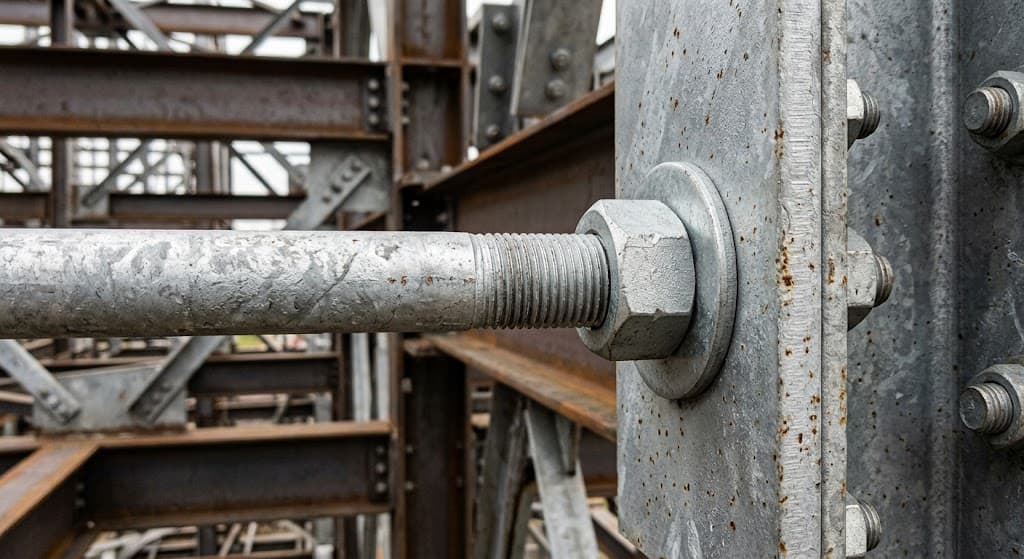
How to Specify Hot Dip Galvanized Tie Rods for Steel Bracing: Diameter, Thread Length and RFQ Checklist
Learn how to specify hot dip galvanized tie rods for steel bracing and tension applications. Check diameter, thread length, coating, matching components and RFQ requirements.
How to Select Hot Dip Galvanized Washers for Steel Structures
Learn how to select hot dip galvanized flat, square and beveled washers for steel structures. Compare washer functions, bolt compatibility, corrosion protection and RFQ requirements.
Want to know more?
Get in touch with us for more information about our services and products.